




A decline in demand is being recorded both in the commercial sector and among public-sector customers, with the public sector contributing the most significant share to the overall negative trend. The expected increase in procurement linked to the upcoming elections to the State Duma of the Russian Federation did not materialize: political organizations’ advertising budgets were substantially below their 2024 level.
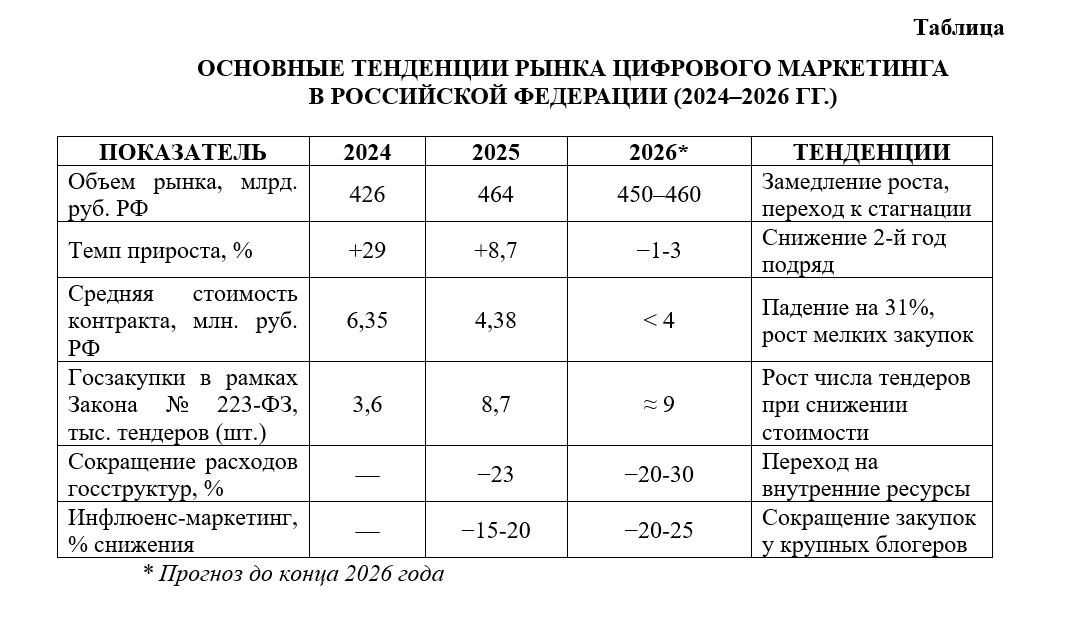
The market’s slowdown has been observed for the second year in a row. In 2025, growth rates fell by more than threefold: after increasing by 29% in 2024, the market grew only 8.7%, reaching 464 billion rubles. The key factors were a large-scale reduction in businesses’ marketing budgets and a decline in government agencies’ purchases of digital services. The most significant spending reduction was recorded in the government services segment—down 23% versus the previous year. Reductions were also observed in the chemical industry, publishing, metallurgy, and the sports industry (see the Table for details).
Analysis of data for the first half of 2026 is complicated by the long cycle of project execution and payment in the digital services segment. Nevertheless, researchers note an increase in the number of payment deferrals, postponements, and cancellations (non-launch) of previously approved campaigns. According to expert estimates, the combined impact of these factors may lead to a reduction in public-sector customers’ spending by tens of percent.
Structural changes are also being observed in the public procurement system. The number of tenders under Federal Law No. 223-FZ of 18.07.2011 “On the procurement of goods, works, and services by certain types of legal entities” (hereinafter, Law No. 223-FZ) increased by more than 2.4 times, reaching 8.7 thousand; however, the average contract value decreased by 31%—from 6.35 million to 4.38 million rubles. This indicates a redistribution of demand toward small and medium-sized procurements, reflecting customers’ desire to minimize financial risks and increase project manageability.
In the commercial sector, the market is characterized by stagnation and a redistribution of budgets in favor of tools with highly measurable effectiveness. Demand is declining for branding, creative strategies, complex special projects, and influencer marketing with major bloggers—the volume of procurement in this segment fell by 15%–20%. Among the key reasons, market participants cite the high key rate, declining business margins, and changes in consumer behavior.
Overall, the identified trends point to the formation of a new operating model for the digital services market, characterized by heightened uncertainty, a lengthening financial cycle, and a shift in demand toward short-term instruments. According to experts, market participants’ adaptation to these conditions will continue through the end of 2026.
Author: Candidate of Economic Sciences, Associate Professor, Department of World Economy and World Finance, Financial University under the Government of the Russian Federation, Moscow Aleksey Alekseevich Soluyanov.

