




On August 27, the Bank of Korea raised its policy rate by 0.25 pp (to 3%), marking the second consecutive hike. At the same time, the regulator revised up its forecast for the country’s real GDP growth in 2026 from 2.6% to 3.3%. The rate increase comes amid persistent inflationary pressure and stronger-than-expected economic activity. One of the key factors behind the upgraded forecast, according to the Bank of Korea, is steady growth in exports and investment supported by strong momentum in the semiconductor sector. (Source: Bank of Korea, 27.08.2026; Reuters, 27.08.2026).
At first glance, raising the rate while upgrading the GDP forecast may appear contradictory, since tighter financial conditions usually constrain consumption and investment. However, South Korea’s historical dynamics show that there is virtually no direct relationship between the level of the policy rate and current economic growth. A comparison of these indicators since 2010 is shown in Figure 1.
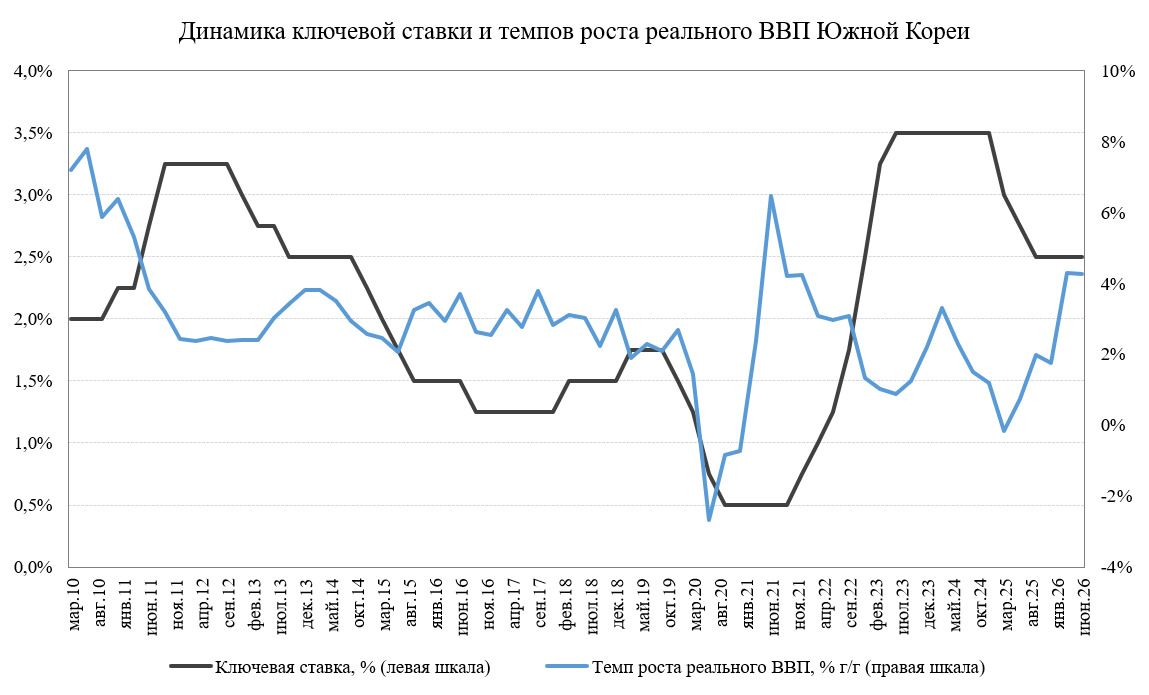
Fig. 1. Dynamics of the Bank of Korea’s policy rate and South Korea’s real GDP growth in 2010–2026 (Source: Bank of Korea)
As shown in Figure 1, periods of rate hikes repeatedly coincided with continued positive growth. For example, in 2010–2011 the rate rose from 2% to 3.25%, while real GDP continued to grow at roughly 2.4–7.8% y/y. The pandemic period of 2020 is also illustrative: despite the policy rate being cut to a record low of 0.5%, real GDP in Q2 fell by 2.69% y/y. The correlation coefficient calculated from quarterly data between the policy rate level and real GDP growth in 2010–2026 is about -0.005, meaning that a statistical linear relationship between the indicators is virtually absent. However, this does not mean that monetary policy has no impact on the economy, since the effect of rate changes materializes with a lag and depends on the current phase of the business cycle, while GDP dynamics are simultaneously influenced by a wide range of other factors.
The current situation is distinguished прежде всего by strong support from technology exports. The Bank of Korea links the acceleration of the economy to the growth of the semiconductor sector, which benefits from the global expansion of investment in artificial intelligence infrastructure. According to Reuters, South Korea’s exports in August may increase by about 62.6% year-on-year following 63% growth in July, with demand for semiconductors remaining the key driver. (Source: Reuters, 28.08.2026).
Raising the rate to 3% does not yet look like a factor capable of significantly constraining the growth of the South Korean economy. Rather, it reflects fairly strong current conditions that allow the regulator to combat inflation risks without a sharp deterioration in economic activity. At the same time, dependence on semiconductor production and exports increases the economy’s sensitivity to global technology demand. If investment demand for AI infrastructure persists, South Korea will be able to sustain growth even under tighter monetary policy. If this demand weakens, the impact of a high rate on business activity will become more noticeable.
Author: Assistant Lecturer at the Department of World Economy and World Finance, Financial University under the Government of the Russian Federation Nikita Dmitrievich Klevanets.


